Eiga Sai 2017: Two films
The 20th Eiga Sai, a festival of contemporary Japanese films (Shang Cineplex Cinema 2, July 7-16), has included in its lineup two films where food is a major character. The one is a love letter to an institution in danger of fading away, while the other is an ode to life and human kindness.
"Tsukiji Wonderland" (2016), a documentary by Naotaro Endo (and his debut full-length film), brings us to what is considered as a world-famous and venerable wholesale seafood market in the Tokyo district of Tsukiji, home to an astounding array of fish and other seafood products and the popular tuna auction. As one food critic in the film points out: If the Pyramids of Egypt is a required destination for archeologists, so is Tsukiji Market a required destination for chefs. Even if one has not (unbelievably) heard of the market before (like myself), the film still holds our interest and attention because of the way Endo tackles his subject (and besides, who wouldn't be interested in food?). Yes, the director interviews a number of resource persons (unlike some documentaries where the approach is purely observational, without even a talking-head, like Gianfranco Rosi's "Fire at Sea"), but we can certainly feel the deep enthusiasm, respect and affection that the interviewees have for the subject they are talking about. How the wholesalers and vendors discuss and describe their way of life in the market has the feel of a gangster protecting his turf: there's an unbreachable sense of honor, pride and commitment to be found in their upholding of their position in the market. There's a dark fascination in hearing how these men of the market can oftentimes wield their "power" through a competitive "manipulation" of their fellow wholesalers in order to get the best deal or by way of "impaling the spine" of their fresh catch so that these can be sold properly (done in a blunt manner, as if we're watching a crime scene in a gangster film). The difference, of course, is that what these "gangsters" of the market is doing is acceptably legal.
For those of us who don't have the means to travel to Tsukiji, watching the documentary is good enough to orient ourselves with the market, as Endo documented it for several months starting in 2014, passing through all of Japan's four seasons, with chapters that pertain to the essential whats and hows of the market's operations and principles. Suffice it to say that the film amounts to a travelogue that brims with passion and nutrition. There's likewise something to be learned from the values of hardwork, earnestness and dedication to quality service that the market-people exhibit. These values shouldn't just be peculiar to a specific nation, but rather universal for all of humanity. But perhaps what's really of immediate concern (specially that it's a lingering issue of late) is the planned relocation of the market to Toyosu, which experts deem as less commercially-viable (due to the distance) and prone to health risks (due to the toxic wastes in the area). Such relocation is actually mentioned in the film only until the very end, which makes everything that preceded tinged with a sense of loss and longing. It's like a twist-ending in a genre movie, with things now being turned upside-down (assuming that one has no clue whatsoever about the issue beforehand). The downside is that everything that we've previously seen and heard won't probably matter anymore in the near future. Nevertheless, "Tsukiji Wonderland" is a wonderful love letter not just to a legendary institution, but to a distinctive way of life.
"Sweet Bean" (2015), written and directed by Naomi Kawase, is a food for the soul, in both the literal and figurative sense. Dorayaki, a popular Japanese street food made up of two small pancakes filled with an (sweet red bean paste) in the middle, figures prominently in the film. It's the food item being sold in a modest stall being manned by the morose Sentaro (played by Masatoshi Nagase) which, unfortunately, doesn't seem to attract much customers (except for a trio of bubbly high-school girls and one equally lonely teener, who's being asked by her mother to discontinue attending school), all because of the rather lackluster quality of the dorayaki. But this is about to change upon the arrival of a 76-year-old woman named Tokue (played by Kirin Kiki), whom Sentaro employs in the store as an assistant (after an initial reluctance and after the latter was able to taste the an cooked by the former, which the man describes as "incredible"). As in any representative work of the foodie-movie subgenre of the art-house cinema (like "Babette's Feast" from Denmark and "Eat Drink Man Woman" from Taiwan), the preparation of the food here is a joy to watch, being meticulously invested with love, soul and philosophy. Indeed, cooking is both an art and a craft that must be mastered and nurtured. While eating, on the other hand, constitutes a divine act in itself, fully savoring with adoration and respect the gift from heaven. True enough, with Tokue now cooking the an (while Sentaro still prepares the pancakes), the dorayaki has acquired such a heavenly taste that the store has attracted more customers than they could've hoped for. Suffice it to say that Tokue is like an angel sent to Sentaro, helping him to spice up a rather drab business.
While it's easy to be enamored of the misanthropic and nihilistic cinema of Michael Haneke and Lars von Trier, it's still refreshing and uplifting to watch a film that celebrates the simple joys of life and the basic acts of human kindness, as what "Sweet Bean" does in a way that doesn't feel too syrupy and pandering. We can see how Tokue, despite her frail age and being afflicted with a disease (a crucial dramatic element in the film), still takes immense delight in the beauty of her natural surroundings (a major motif in the film, which actually undergoes through different seasons, as seen in how the cherry blossom trees change) and expresses goodwill in her relationship with others. While Sentaro, without him fully realizing it, is able to bring joy to the life of another person just by simply being kind. It's through being selfless that the film elevates the self. And as in "Tsukiji Wonderland", "Sweet Bean" fosters the values of hardwork, patience and commitment to quality service which, as already pointed out above, shouldn't only be specific to a particular nation. There's really a lot of wonderful life-lessons to be learned from the two films, by both the young and the old. Sometimes, we want our cinema to be just like that - torchbearers of hope, love and compassion.
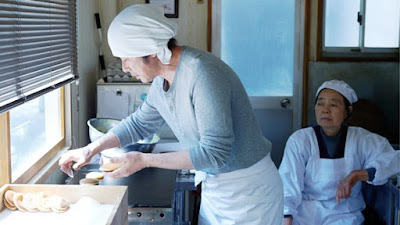
(The cook and his assistant prepare a nourishment for the soul in Naomi Kawase's "Sweet Bean")
"Tsukiji Wonderland" (2016), a documentary by Naotaro Endo (and his debut full-length film), brings us to what is considered as a world-famous and venerable wholesale seafood market in the Tokyo district of Tsukiji, home to an astounding array of fish and other seafood products and the popular tuna auction. As one food critic in the film points out: If the Pyramids of Egypt is a required destination for archeologists, so is Tsukiji Market a required destination for chefs. Even if one has not (unbelievably) heard of the market before (like myself), the film still holds our interest and attention because of the way Endo tackles his subject (and besides, who wouldn't be interested in food?). Yes, the director interviews a number of resource persons (unlike some documentaries where the approach is purely observational, without even a talking-head, like Gianfranco Rosi's "Fire at Sea"), but we can certainly feel the deep enthusiasm, respect and affection that the interviewees have for the subject they are talking about. How the wholesalers and vendors discuss and describe their way of life in the market has the feel of a gangster protecting his turf: there's an unbreachable sense of honor, pride and commitment to be found in their upholding of their position in the market. There's a dark fascination in hearing how these men of the market can oftentimes wield their "power" through a competitive "manipulation" of their fellow wholesalers in order to get the best deal or by way of "impaling the spine" of their fresh catch so that these can be sold properly (done in a blunt manner, as if we're watching a crime scene in a gangster film). The difference, of course, is that what these "gangsters" of the market is doing is acceptably legal.
For those of us who don't have the means to travel to Tsukiji, watching the documentary is good enough to orient ourselves with the market, as Endo documented it for several months starting in 2014, passing through all of Japan's four seasons, with chapters that pertain to the essential whats and hows of the market's operations and principles. Suffice it to say that the film amounts to a travelogue that brims with passion and nutrition. There's likewise something to be learned from the values of hardwork, earnestness and dedication to quality service that the market-people exhibit. These values shouldn't just be peculiar to a specific nation, but rather universal for all of humanity. But perhaps what's really of immediate concern (specially that it's a lingering issue of late) is the planned relocation of the market to Toyosu, which experts deem as less commercially-viable (due to the distance) and prone to health risks (due to the toxic wastes in the area). Such relocation is actually mentioned in the film only until the very end, which makes everything that preceded tinged with a sense of loss and longing. It's like a twist-ending in a genre movie, with things now being turned upside-down (assuming that one has no clue whatsoever about the issue beforehand). The downside is that everything that we've previously seen and heard won't probably matter anymore in the near future. Nevertheless, "Tsukiji Wonderland" is a wonderful love letter not just to a legendary institution, but to a distinctive way of life.
"Sweet Bean" (2015), written and directed by Naomi Kawase, is a food for the soul, in both the literal and figurative sense. Dorayaki, a popular Japanese street food made up of two small pancakes filled with an (sweet red bean paste) in the middle, figures prominently in the film. It's the food item being sold in a modest stall being manned by the morose Sentaro (played by Masatoshi Nagase) which, unfortunately, doesn't seem to attract much customers (except for a trio of bubbly high-school girls and one equally lonely teener, who's being asked by her mother to discontinue attending school), all because of the rather lackluster quality of the dorayaki. But this is about to change upon the arrival of a 76-year-old woman named Tokue (played by Kirin Kiki), whom Sentaro employs in the store as an assistant (after an initial reluctance and after the latter was able to taste the an cooked by the former, which the man describes as "incredible"). As in any representative work of the foodie-movie subgenre of the art-house cinema (like "Babette's Feast" from Denmark and "Eat Drink Man Woman" from Taiwan), the preparation of the food here is a joy to watch, being meticulously invested with love, soul and philosophy. Indeed, cooking is both an art and a craft that must be mastered and nurtured. While eating, on the other hand, constitutes a divine act in itself, fully savoring with adoration and respect the gift from heaven. True enough, with Tokue now cooking the an (while Sentaro still prepares the pancakes), the dorayaki has acquired such a heavenly taste that the store has attracted more customers than they could've hoped for. Suffice it to say that Tokue is like an angel sent to Sentaro, helping him to spice up a rather drab business.
While it's easy to be enamored of the misanthropic and nihilistic cinema of Michael Haneke and Lars von Trier, it's still refreshing and uplifting to watch a film that celebrates the simple joys of life and the basic acts of human kindness, as what "Sweet Bean" does in a way that doesn't feel too syrupy and pandering. We can see how Tokue, despite her frail age and being afflicted with a disease (a crucial dramatic element in the film), still takes immense delight in the beauty of her natural surroundings (a major motif in the film, which actually undergoes through different seasons, as seen in how the cherry blossom trees change) and expresses goodwill in her relationship with others. While Sentaro, without him fully realizing it, is able to bring joy to the life of another person just by simply being kind. It's through being selfless that the film elevates the self. And as in "Tsukiji Wonderland", "Sweet Bean" fosters the values of hardwork, patience and commitment to quality service which, as already pointed out above, shouldn't only be specific to a particular nation. There's really a lot of wonderful life-lessons to be learned from the two films, by both the young and the old. Sometimes, we want our cinema to be just like that - torchbearers of hope, love and compassion.
(The cook and his assistant prepare a nourishment for the soul in Naomi Kawase's "Sweet Bean")

Comments