Kazoku:Eiga Sai 2014, Day 4
On Eiga Sai's day three, we saw a couple of films that center on persons who come into and go out of their families' lives. For the festival's fourth day, let's find out how this particular film that I saw dealt with the subject of family, the theme of this year's film festival.
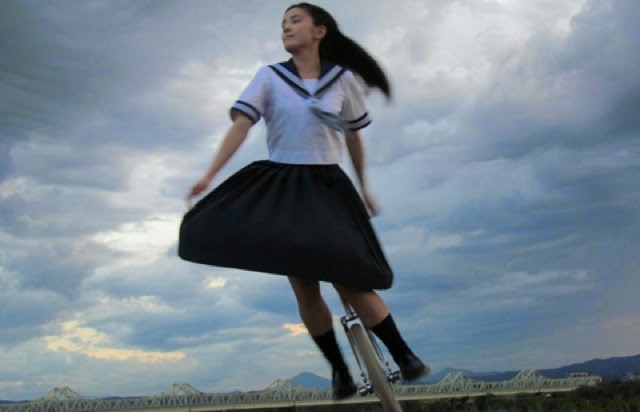
• "Casting Blossoms to the Sky" by Nobuhiko Ôbayashi (160 mins)
Before I saw the film, the one thing about it that immediately caught my attention and eagerly made me want to see it was the director himself, Nobuhiko Ôbayashi. Coming from the man who made "House", a 1977 film that became a cult favorite because of its distinctive lunacy and strangeness and eye-popping visuals, I was somehow expecting that "Casting Blossoms to the Sky" would be of the same mold. And it surely is (with the director now at age 74)! Of the films that I saw at the Eiga Sai so far, this might be the only one that isn't for everyone's taste. At the start of the film, we are told that it's going to be a "film essay", which should have given us a clue that what is to follow is out of the ordinary. Come to think of it, the underlying theme of the film is not hard to decipher:its anti-war message is as clear as the crystal-blue sky. Its subject is even based on facts, not a figment of the director's wild imagination:Japan's painful experiences during World War II and the Great East Japan Earthquake, as seen from the vantage point of the provincial town of Nagaoka. But the way the characters speak (or "narrate" the facts) and the inter-cutting of scenes are done in a rapid-fire fashion that it may take some time before viewers can take hold of themselves. Everything is just overwhelming that one may head for the exit in order to catch one's breath - it's up to one whether to still go back inside or not. Add to this is how a number of setpieces are presented in a truly loony manner that one starts to wonder whether what we are actually seeing is more of a madhouse than a "wonderland", as the lead female character (a news journalist) calls it. Though on the other hand, this may make sense if we consider that, after all, war is madness;that once in it, everything - one's family and the nation as a whole - is bound to be sacrificed.
But it has to be admitted that one thing that keeps us from totally giving up on the film is its arresting visual aesthetics, which has a dream-like and psychedelic quality to it. Truly imaginative and eye-popping, Ôbayashi couldn't have handled it otherwise. His fantastic way with colors, lighting, sets, camera angles and visual effects constitutes a real eye-candy. It can't be doubted that there's a mad genius at work here! Also, the film's argument for fireworks as a means of pacifism is interesting and innovative, culminating in a grandiose and euphoric display towards the end. Though the danger in all of these is that the fantastical visuals may really overwhelm the underlying seriousness of intent. But the director doesn't seem to lose sight of it, as the anti-war sentiment comes out loud and clear from every nook and cranny of the film.
(Nobuhiko Ôbayashi's "Casting Blossoms to the Sky":Hana, the girl on a unicycle, one of the director's eccentric touches in the film.)
Comments